How-to
सफेद बालों में मेहंदी कैसे लगाएं: समय, तरीका और सही मेहंदी
सफेद बालों पर सिर्फ मेहंदी से तांबे जैसा रंग आता है। भूरे या काले रंग के लिए मेहंदी 3–4...
Read

Henna alone turns greys copper. Here's how the two-step henna and indigo method covers grey and white hair naturally — and how many applications to expect.
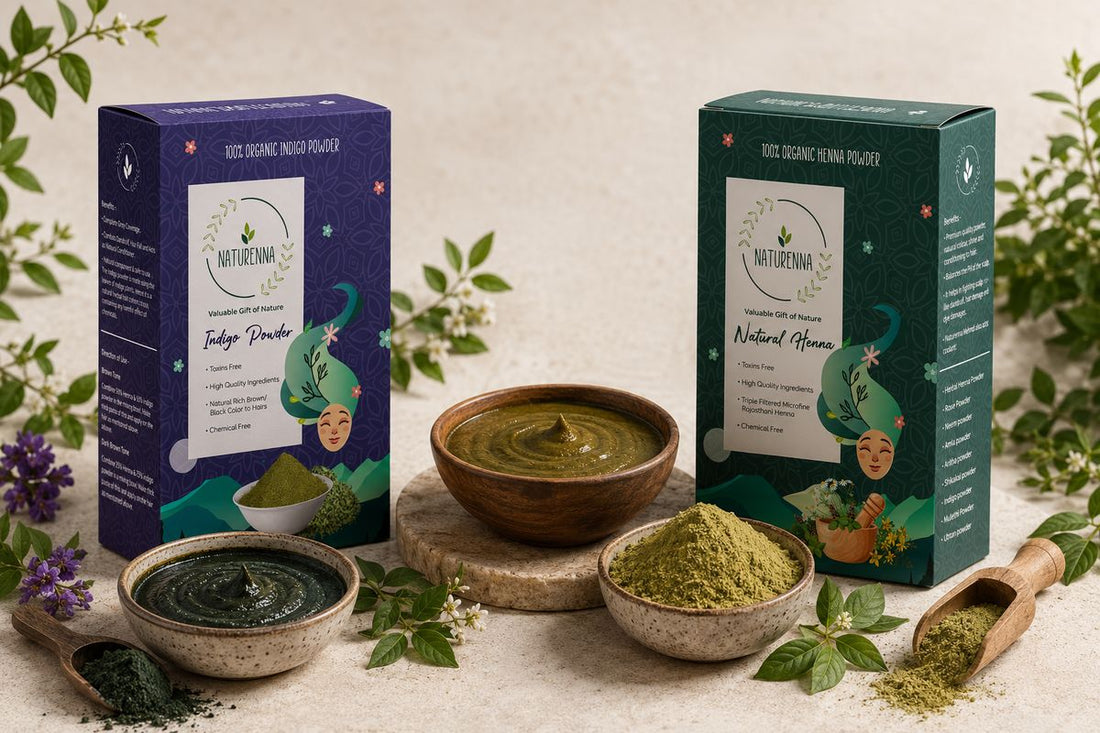
Henna alone turns grey hair bright copper-orange, not brown or black. To colour greys naturally, apply henna first to lay a warm base, then indigo on top: the two-step method. Greys take colour slowly, so the shade deepens over the first two or three applications, then you only touch up roots every 3 to 4 weeks.
Want both powders in one set? The Natural Henna + Indigo Combo packs them separately for exactly this method.
| Shade you want | Henna | Then indigo | Rounds on greys |
|---|---|---|---|
| Warm to medium brown | 2–3 hours | 30–45 minutes | 1–2 |
| Dark brown | 3–4 hours | About 1 hour | 2 |
| Near black | 3–4 hours | 1.5–2 hours | 2–3, a few days apart |
| Root touch-up | 2–3 hours, roots only | About 1 hour, roots only | Every 3–4 weeks |
These are starting points, not guarantees. Hair texture, how much white you have and your water all change the result. Note what you did each time and adjust the indigo time in the next round.
Henna is a leaf powder that stains hair with a warm red-orange pigment. On dark hair that shows as a subtle reddish glow. On grey and white hair there is no natural pigment underneath, so henna shows its true colour: bright copper. Our guide on whether henna turns hair orange explains this in detail.
Indigo is a different plant with a deep blue pigment. Layered over a henna base, the blue combines with the orange and moves the shade towards brown or black. Indigo on its own tends to look patchy or greenish-blue on white hair because it has no warm base to sit on. Henna lays the base; indigo deepens it.
Both are plant powders. Our henna and indigo contain no PPD, no metallic salts and no synthetic dyes, a common concern with box dyes and so-called 'black henna'. How the plant route compares with other options is in PPD-free natural hair colour for grey hair.
Do a patch test on a small area 48 hours before your first full application.
For the full black-shade routine, read henna then indigo for natural black.
| Application | What greys usually look like |
|---|---|
| First | Copper or warm brown. Most greys are coloured, but not yet deep |
| Second and third | The shade deepens and evens out as more pigment layers on |
| After that | Fairly stable; refresh roots and any faded patches only |
Most people touch up roots every 3 to 4 weeks, depending on how fast their hair grows and how much white they have. If your hair carries box dye from before, read henna on chemically coloured hair first, and if you are still choosing a product, see which natural hair colour to choose.
Henna colours grey hair, but the result is copper-orange. For brown or black, follow henna with indigo.
Yes. White hair takes henna strongly, which is why the orange is so visible, and indigo on top moves it to brown or black. Expect it to build over a few applications.
You can, for brown. On greys the two-step method usually gives a deeper, more even result than one mixed paste.
Not usually. Greys colour gradually, so the shade deepens over the first two or three applications.
Henna and indigo are plant powders that coat the hair with pigment, with no PPD, ammonia or peroxide. Our powders are pure leaf, triple-sifted and batch-coded, and our henna is single-origin from Sojat.
Single-origin Sojat henna and pure indigo, packed separately for the two-step method. No PPD, no metallic salts, no synthetic dyes.
Shop the Henna + Indigo Combo
सफेद बालों पर सिर्फ मेहंदी से तांबे जैसा रंग आता है। भूरे या काले रंग के लिए मेहंदी 3–4...

The PPD-free way to colour grey hair brown or black is henna first, then indigo. A comp...

Yes, with pure henna: wait 2 to 4 weeks after chemical dye or bleach and strand-test fi...
Herbal hair tips, restock alerts and members-only offers — no clutter, just the good stuff.