How-to
How to mix henna for the richest natural colour
Water temperature, resting time and the one step most people skip. A foolproof method f...
Read

The soil, the heat and three generations of know-how — what makes one district in Rajasthan the henna capital of the world.
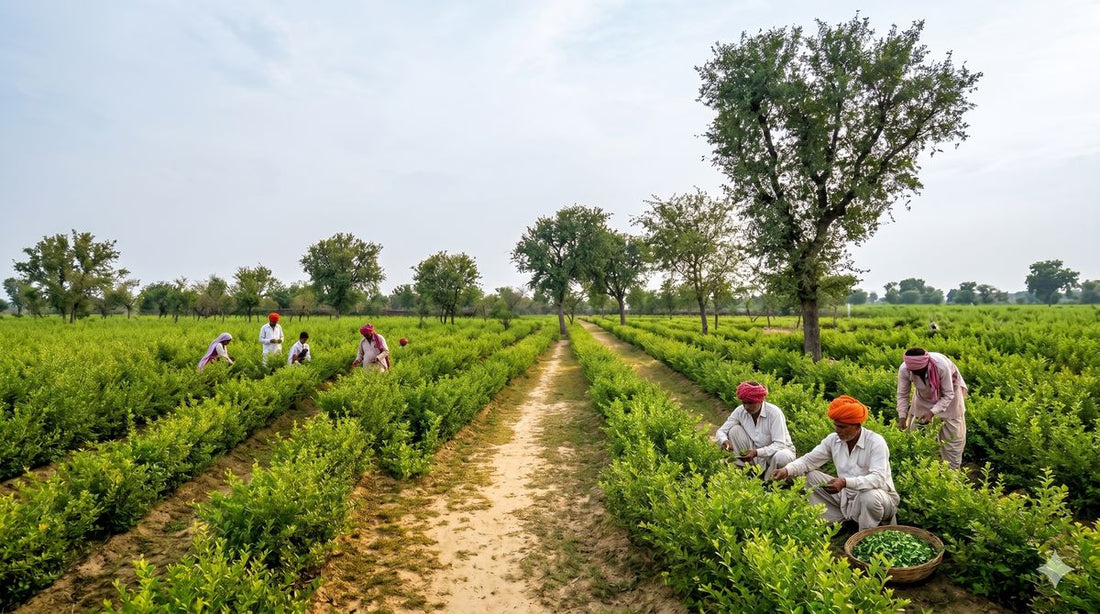
If you have ever wondered why two packets of henna can behave completely differently on the same head of hair, the answer usually begins long before the powder is milled — in the field where the plant was grown.
Henna (Lawsonia inermis) grows across the dry belts of South Asia, the Middle East and North Africa. But not all of it is equal. The strength of the dye, the smoothness of the paste and the richness of the final colour all trace back to one thing: how much lawsone the leaf carries. And lawsone, it turns out, is fussy about where it grows.
Henna rewards heat, dry air and poor soil — exactly the conditions that make most crops struggle. Sojat, in Rajasthan's Pali district, offers all three in abundance. Long, punishing summers push the plant to concentrate lawsone in its leaves as a defence against the sun. The result is a leaf with naturally higher dye content than henna grown in cooler, wetter regions.
The same sun that makes Sojat hard to farm is what makes its henna worth seeking out.
This is why Sojat is known, without much argument, as the henna capital of the world. The district doesn't just grow henna — it grows, dries, mills and trades it at a scale and skill that has been refined over generations.
Growing a strong leaf is only half the story. Lawsone is delicate. Heat, light and time all degrade it, which means henna can lose much of its potency between the farm and your bathroom shelf if it is handled carelessly or stored for too long.
Most henna changes hands several times — farmer, trader, blender, packer, distributor — and each stop adds delay and often a little adulteration. A shorter chain keeps the leaf fresher and the colour truer. That is the whole idea behind sourcing at the origin:
You don't need a lab. Pure henna smells green and grassy, mixes into a smooth paste without grit, and lists a single ingredient. If a pack promises "black in one hour" or lists chemicals you can't pronounce, it isn't pure henna — it's a dye wearing henna's name. We go deeper on this in our guide to reading a henna label.
Single-origin, triple-sifted, batch-coded from farm to pack.
Shop Pure Sojat HennaWhen the field is right and the chain is short, henna does what it has done for centuries — colour and condition hair with nothing but a plant. That is the standard Sojat set long before any of us arrived, and the one we simply try not to get in the way of.

Water temperature, resting time and the one step most people skip. A foolproof method f...

The single molecule behind henna's colour and shine, explained simply — and why pure le...

Skip the chemical dye. Here's how to layer henna and indigo, in the right order, for de...
Herbal hair tips, restock alerts and members-only offers — no clutter, just the good stuff.